

Home
- ▶
- Heaters/Source
- ▶
- Agilent Heaters and SensorsMass Spectrometry, Scientific Supplies & ManufacturingScientific Instrument Services 5973 Source Heater Tamper Resistant Allen Wrench 5973/5975 Quad Sensor 5985 Source Heater Assembly Agilent Interface Heater Assembly 5971 Interface Heater
- ▶
- Literature (This Page)
Pages containing matching text:
Reference Literature
 MSDS Sheet - FABC2 Calibration Compound - Material Safety Data Sheet - </referenc/articles/fabc2.htm> /5
 Local US Chromatography Discussion Groups - Listing of - The following local chromatography discussion groups provide chromatographers the opportunity to meet with other chromatographers to discuss their work and to mix socially with peers. - </referenc/sites/chmtgrop.htm> /5
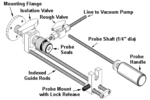 Note 49: Analysis of Cocaine Utilizing a New Direct Insertion Probe on a Hewlett Packard 5973 MSD - Analysis of Cocaine Utilizing a New Direct Insertion Probe on a Hewlett Packard 5973 MSD - </referenc/applnote/app-49.htm> /5
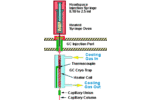 Note 28: Analysis Of Volatile Organics In Latex Paints By Automated Headspace Sampling and GC Cryo-Focusing - Analysis Of Volatile Organics In Latex Paints By Automated Headspace Sampling and GC Cryo-Focusing - </referenc/applnote/app-28.htm> /5
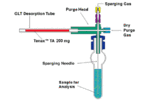 Note 55: Seasonal Variation in Flower Volatiles - Thermal Desorption Analysis of Flowers - </referenc/applnote/app-55.htm> /5
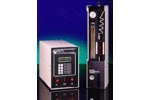 Tech 1 - Design and Operation of the Short Path Thermal Des. sys - Technical Bulletin No. 1 October 1990 Part I - Design & Operation of the Short Path Thermal Desorption System John J. Manura Scientific Instrument Services, Ringoes, NJ Figure 1 - The Short Path Thermal Desorption System, Model TD1. Introduction A new accessory for the thermal desorption and direct thermal analysis of samples into a Gas Chromatograph (GC) has just been introduced by Scientific Instrument Services, Inc. (S.I.S.) This new instrument is the combined effort of Scientific Instru... - </referenc/articles/tech1.htm> /5 CRIMS - chemical reaction interface mass spectrometry - The CRIMS technique allows stable isotopes to be used in a wide variety of tagging and tracing applications. In CRIMS, chromatography effluent is decomposed in a high-temperature microwave plasma and then reacted with a reactant gas. This results in a small number of well characterized polyatomic products whose isotopic ratios are measured by mass spectrometry in order to identify and quantify the presence of isotope tags, independent of chemical structure or environment. - </ms/sis/crims.htm> /1