

- ▶
- Heaters/Source
- ▶
- Agilent Heaters and SensorsMass Spectrometry, Scientific Supplies & ManufacturingScientific Instrument Services 5973 Source Heater Tamper Resistant Allen Wrench 5973/5975 Quad Sensor 5985 Source Heater Assembly Agilent Interface Heater Assembly 5971 Interface Heater
- ▶
- Filaments
- LiteratureApplication Notes Adsorbent Resins Guide Mass Spec Tips SDS Sheets FAQ MS Calibration Compound Spectra Manuals MS Links/Labs/ Organizations MS Online Tools Flyers on Products/Services Scientific Supplies Catalog About Us NextAdvance Bullet Blender® Homogenizer Protocols Micro-Mesh® Literature Instrumentation Literature Agilent GC/MS Literature SIS News / E-Mail Newsletter NIST MS Database - Update Notifications

- ▶
- Application NotesNote 103: EPA Method 325B, Novel Thermal Desorption Instrument Modification to Improve Sensitivity Note 102: Identification of Contaminants in Powdered Beverages by Direct Extraction Thermal Desorption GC/MS Note 101: Identification of Contaminants in Powdered Foods by Direct Extraction Thermal Desorption GC/MS Note 100: Volatile and Semi-Volatile Profile Comparison of Whole Versus Cracked Versus Dry Homogenized Barley Grains by Direct Thermal Extraction Note 99: Volatile and Semi-Volatile Profile Comparison of Whole vs. Dry Homogenized Wheat, Rye and Barley Grains by Direct Thermal Extraction GC/MS Note 98: Flavor and Aroma Profiles of Truffle Oils by Thermal Desorption GC/MS Note 97: Flavor Profiles of Imported and Domestic Beers by Purge & Trap Thermal Desorption GC/MS Note 96: Reducing Warping in Mass Spectrometer Filaments, with SISAlloy® Yttria/Rhenium Filaments Note 95: Detection of Explosives on Clothing Material by Direct and AirSampling Thermal Desorption GC/MS Note 94: Detection of Nepetalactone in the Nepeta Cataria Plant by Thermal Desorption GC/MS Note 93: Detection of Benzene in Carbonated Beverages with Purge & Trap Thermal Desorption GC/MS Note 92: Yttria Coated Mass Spectrometer Filaments Note 91: AutoProbe DEP Probe Tip Temperatures Note 90: An Automated MS Direct Probe for use in an Open Access Environment Note 89: Quantitation of Organics via a Mass Spectrometer Automated Direct Probe Note 88: Analysis of Silicone Contaminants on Electronic Components by Thermal Desorption GC-MS Note 87: Design and Development of an Automated Direct Probe for a Mass Spectrometer Note 86: Simulation of a Unique Cylindrical Quadrupole Mass Analyzer Using SIMION 7.0. Note 85: Replacing an Electron Multiplier in the Agilent (HP) 5973 MSD Note 84: Vacuum Pump Exhaust Filters - Charcoal Exhaust Traps Note 83: Vacuum Pump Exhaust Filters - Oil Mist Eliminators Note 82: Vacuum Pump Exhaust Filters Note 81: Rapid Bacterial Chemotaxonomy By DirectProbe/MSD Note 80: Design, Development and Testing of a Microprocessor ControlledAutomated Short Path Thermal Desorption Apparatus Note 79: Volatile Organic Compounds From Electron Beam Cured and Partially Electron Beam Cured Packaging Using Automated Short Path Thermal Desorption Note 78: A New Solution to Eliminate MS Down-Time With No-Tool-Changing of Analytical GC Columns Note 77: The Determination of Volatile Organic Compounds in VacuumSystem Components Note 76: Determination of the Sensitivity of a CRIMS System Note 75: An Apparatus for Sampling Volatile Organics From LivePlant Material Using Short Path Thermal Desorption Note 74: Examination of Source Design in Electrospray-TOF Using SIMION 3D Note 73: The Analysis of Perfumes and their Effect on Indoor Air Pollution Note 72: 1998 Version of the NIST/EPA/NIH Mass Spectral Library, NIST98 Note 71: Flavor Profile Determination of Rice Samples Using Shor tPath Thermal Desorption GC Methods Note 70: Application of SIMION 6.0 To a Study of the Finkelstein Ion Source: Part II Note 69: Application of SIMION 6.0 To a Study of the Finkelstein Ion Source: Part 1 Note 68: Use of a PC Plug-In UV-Vis Spectrometer To Monitor the Plasma Conditions In GC-CRIMS Note 67: Using Chemical Reaction Interface Mass Spectrometry (CRIMS) To Monitor Bacterial Transport In In Situ Bioremediation Note 66: Probe Tip Design For the Optimization of Direct Insertion Probe Performance Note 65: Determination of Ethylene by Adsorbent Trapping and Thermal Desorption - Gas Chromatography Note 64: Comparison of Various GC/MS Techniques For the Analysis of Black Pepper (Piper Nigrum) Note 63: Determination of Volatile and Semi-Volatile Organics in Printer Toners Using Thermal Desorption GC Techniques Note 62: Analysis of Polymer Samples Using a Direct Insertion Probe and EI Ionization Note 61: Analysis of Sugars Via a New DEP Probe Tip For Use With theDirect Probe On the HP5973 MSD Note 60: Programmable Temperature Ramping of Samples Analyzed ViaDirect Thermal Extraction GC/MS Note 59: Computer Modeling of a TOF Reflectron With Gridless Reflector Using SIMION 3D Note 58: Direct Probe Analysis and Identification of Multicomponent Pharmaceutical Samples via Electron Impact MS Note 57: Aroma Profiles of Lavandula species Note 56: Mass Spec Maintenance & Cleaning Utilizing Micro-Mesh® Abrasive Sheets Note 55: Seasonal Variation in Flower Volatiles Note 54: Identification of Volatile Organic Compounds in Office Products Note 53: SIMION 3D v6.0 Ion Optics Simulation Software Note 52: Computer Modeling of Ion Optics in Time-of-Flight mass Spectrometry Using SIMION 3D Note 51: Development and Characterization of a New Chemical Reaction Interface for the Detection of Nonradioisotopically Labeled Analytes Using Mass Spectrometry (CRIMS) Note 50: The Analysis of Multiple Component Drug Samples Using a Direct Probe Interfaced to the HP 5973 MSD Note 49: Analysis of Cocaine Utilizing a New Direct Insertion Probe on a Hewlett Packard 5973 MSD Note 48: Demonstration of Sensitivity Levels For the Detection of Caffeine Using a New Direct Probe and Inlet for the HP 5973 MSD Note 47: The Application Of SIMION 6.0 To Problems In Time-of-Flight Mass Spectrometry Note 46: Delayed Extraction and Laser Desorption: Time-lag Focusing and Beyond Note 45: Application of SIMION 6.0 to Filament Design for Mass Spectrometer Ionization Sources Note 44: The Design Of a New Direct Probe Inlet For a Mass Spectrometer Note 43: Volatile Organic Composition In Blueberries Note 42: The Influence of Pump Oil Purity on Roughing Pumps Note 41: Hydrocarbon Production in Pine by Direct Thermal Extraction Note 40: Comparison of Septa by Direct Thermal Extraction Note 39: Comparison of Sensitivity Of Headspace GC, Purge and Trap Thermal Desorption and Direct Thermal Extraction Techniques For Volatile Organics Note 38: A New Micro Cryo-Trap For Trapping Of Volatiles At the Front Of a GC Capillary Column Note 37: Volatile Organic Emissions from Automobile Tires Note 36: Identification Of Volatile Organic Compounds In a New Automobile Note 35: Volatile Organics Composition of Cranberries Note 34: Selection Of Thermal Desorption and Cryo-Trap Parameters In the Analysis Of Teas Note 33: Changes in Volatile Organic Composition in Milk Over Time Note 32: Selection and Use of Adsorbent Resins for Purge and Trap Thermal Desorption Applications Note 31: Volatile Organic Composition in Several Cultivars of Peaches Note 30: Comparison Of Cooking Oils By Direct Thermal Extraction and Purge and Trap GC/MS Note 29: Analysis Of Volatile Organics In Oil Base Paints By Automated Headspace Sampling and GC Cryo-Focusing Note 28: Analysis Of Volatile Organics In Latex Paints By Automated Headspace Sampling and GC Cryo-Focusing Note 27: Analysis of Volatile Organics In Soils By Automated Headspace GC Note 26: Volatile Organics Present in Recycled Air Aboard a Commercial Airliner Note 25: Flavor and Aroma in Natural Bee Honey Note 24: Selection of GC Guard Columns For Use With the GC Cryo-Trap Note 23: Frangrance Qualities in Colognes Note 22: Comparison Of Volatile Compounds In Latex Paints Note 21: Detection and Identification Of Volatile and Semi-Volatile Organics In Synthetic Polymers Used In Food and Pharmaceutical Packaging Note 20: Using Direct Thermal Desorption to Assess the Potential Pool of Styrene and 4-Phenylcyclohexene In Latex-Backed Carpets Note 19: A New Programmable Cryo-Cooling/Heating Trap for the Cryo-Focusing of Volatiles and Semi-Volatiles at the Head of GC Capillary Columns Note 18: Determination of Volatile Organic Compounds In Mushrooms Note 17: Identification of Volatile Organics in Wines Over Time Note 16: Analysis of Indoor Air and Sources of Indoor Air Contamination by Thermal Desorption Note 14: Identification of Volatiles and Semi-Volatiles In Carbonated Colas Note 13: Identification and Quantification of Semi-Volatiles In Soil Using Direct Thermal Desorption Note 12: Identification of the Volatile and Semi-Volatile Organics In Chewing Gums By Direct Thermal Desorption Note 11: Flavor/Fragrance Profiles of Instant and Ground Coffees By Short Path Thermal Desorption Note 10: Quantification of Naphthalene In a Contaminated Pharmaceutical Product By Short Path Thermal Desorption Note 9: Methodologies For the Quantification Of Purge and Trap Thermal Desorption and Direct Thermal Desorption Analyses Note 8: Detection of Volatile Organic Compounds In Liquids Utilizing the Short Path Thermal Desorption System Note 7: Chemical Residue Analysis of Pharmaceuticals Using The Short Path Thermal Desorption System Note 6: Direct Thermal Analysis of Plastic Food Wraps Using the Short Path Thermal Desorption System Note 5: Direct Thermal Analysis Using the Short Path Thermal Desorption System Note 4: Direct Analysis of Spices and Coffee Note 3: Indoor Air Pollution Note 2: Detection of Arson Accelerants Using Dynamic Headspace with Tenax® Cartridges Thermal Desorption and Cryofocusing Note 1: Determination of Off-Odors and Other Volatile Organics In Food Packaging Films By Direct Thermal Analysis-GC-MS Tech No. "A" Note 14: Elimination of "Memory" Peaks in Thermal Desorption Improving Sensitivity in the H.P. 5971 MSD and Other Mass Spectrometers - Part I of II Improving Sensitivity in the H.P. 5971 MSD and Other Mass Spectrometers- Part II of II Adsorbent Resins Guide Development and Field Tests of an Automated Pyrolysis Insert for Gas Chromatography. Hydrocarbon Production in Pine by Direct Thermal Extraction A New Micro Cryo-Trap for the Trapping of Volatiles at the Front of a GC Capillary (019P) - Comparison of Septa by Direct Thermal Extraction Volatile Organic Composition in Blueberry Identification of Volatile Organic Compounds in Office Products Detection and Indentification of Volatiles in Oil Base Paintsby Headspace GC with On Column Cryo-Trapping Evaluation of Septa Using a Direct Thermal Extraction Technique INFLUENCE OF STORAGE ON BLUEBERRY VOLATILES Selection of Thermal Desorption and Cryo-Trap Parameters in the Analysis of Teas Redesign and Performance of a Diffusion Based Solvent Removal Interface for LC/MS The Design of a New Direct Probe Inlet for a Mass Spectrometer Analytes Using Mass Spectrometry (CRIMS) Application of SIMION 6.0 to Filament Design for Mass Spectrometer Ionization Sources A Student Guide for SIMION Modeling Software Application of SIMION 6.0 to Problems in Time-of-flight Mass Spectrometry Comparison of Sensitivity of Headspace GC, Purge and TrapThermal Desorption and Direct Thermal Extraction Techniques forVolatile Organics The Influence of Pump Oil Purity on Roughing Pumps Analysis of Motor Oils Using Thermal Desorption-Gas Chromatography-Mass Spectrometry IDENTIFICATION OF VOLATILE ORGANIC COMPOUNDS IN PAPER PRODUCTS Computer Modeling of Ion Optics in Time-of-Flight mass Spectrometry using SIMION 3D Seasonal Variation in Flower Volatiles Development of and Automated Microprocessor Controlled Gas chromatograph Fraction Collector / Olfactometer Delayed Extraction and Laser Desorption: Time-lag Focusing and Beyond A New Micro Cryo-Trap for the Trapping of Volatiles at the Front of a GC Column Design of a Microprocessor Controlled Short Path Thermal Desorption Autosampler Computer Modeling of Ion Optics in Time-of-Flight Mass Spectrometry Using SIMION 3D Thermal Desorption Instrumentation for Characterization of Odors and Flavors
- ▶
- Note 92: Yttria Coated Mass Spectrometer Filaments (This Page)
Introduction
Historically most mass spectrometers have used plain uncoated filaments usually constructed of rhenium, tungsten or an alloy of rhenium and tungsten. In the past twenty or so years, several manufactures have tried using thoria (thorium oxide) coated iridium filaments in their mass spectrometers or leak detectors. This thoria and yttria coating technology came out of the vacuum tube industry in the 1940's and early 1950's. The thoria coated iridium filament provides longer filament life because the thoria work function was lower than tungsten, the filament required less power and it operated at lower temperatures. The major disadvantage of thoria is the environmental issues due to the exposure to the alpha particles emitted by thorium. Yttria (Yttrium Oxide) has been used as a replacement by several manufacturers of leak detectors and ion gauge tubes. SIS has been investigating Yttria (Yttrium Oxide) as a replacement for use in mass spectrometer filaments. The work function of Yttrium and Thorium are very similar (3.1 eV versus 3.41 eV respectively) and Yttria does not present the environmental issues associated with Thoria.
Mechanism of Emission
It has been reported by several authors in the early literature that free Yttrium (Y) is released within the Yttrium Oxide coating during the heating of the filament during the activation phase and this free Yttrium (Y) migrates to the surface of the oxide coating. It is this free metal film of Yttrium (Y) on the surface of the oxide coating that results in the emission characteristics of the Yttria coated filaments.
Preparation of Filaments
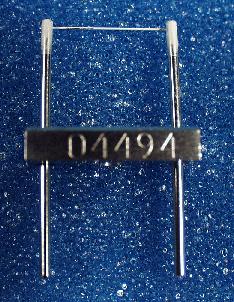
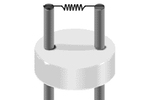
The filament wires were spot welded to metal body filament presses. (Figure 1) The filaments were thoroughly cleaned and Yttria (Yttrium Oxide) was coated onto the filaments using an electrophoretic process. After coating the Yttria onto the filaments, they were inspected for integrity of coating and the film thickness was measured.
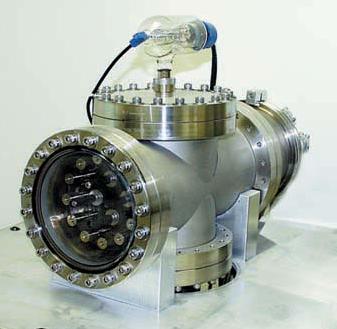
Yttria was coated onto various filaments wires and the emission characteristics were studied. Filaments were tested on the SIS filament testing station shown in Figure 2. This station has been used in filament studies we have published previously and is routinely used to study filament behavior. This filament testing station permits the simultaneous study of up to 12 filaments. The DC voltage and current through each filament can be varied and the emission current between the filament and a collector is measured. The emission voltage between the filament and the collector was set to 70 volts DC, which is the standard emission voltage used in most EI mass spectrometers. For each of the studies as the filament current was increased in 0.1 amp increments, the filament current, the filament voltage and the emission current were measured using 3 digit digital voltage and current meters. Filament temperatures were calculated using the Stefan Boltzman equation using the measured filament current and voltage as well as the physical dimensions of the filament wire.
Comparison of Thoria and Yttria Coatings
The chart (Figure 3) compares two Iridium filaments, one coated with Thoria (Thorium Oxide) and the other with Yttria (Yttrium Oxide). The filaments consisted of a filament press with a 10.0 mm length of 0.007" diameter Iridium wire. Yttria and Thoria were electrophoretically deposited on the filament wires to a thickness of 0.0005".
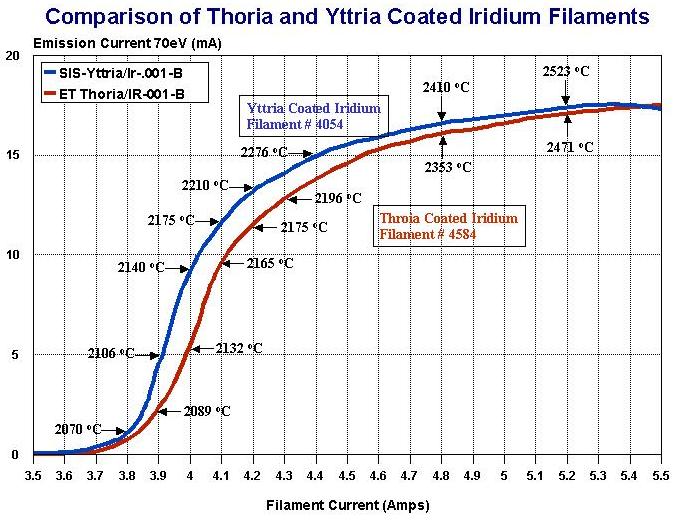
As can be seen from the chart (Figure 3) the emission currents of the Yttria and Thoria filaments are very similar. For both the thoria and yttria coated filaments, the filament operates at about 2200°C to achieve 10 mA of emission current. This study and the following studies confirm the feasibility of using Yttria as a replacement for Thoria on filaments for mass spectrometers.
Study of Yttria Coated Rhenium Filaments
Rhenium filaments were coated with Yttria to determine its application for mass spectrometer filament manufacture. Emission plots of both Rhenium and Yttria coated Rhenium are shown below. Rhenium by itself has often been used as a mass spectrometer filament and therefore emits over a broad current range as shown in Figure 4.
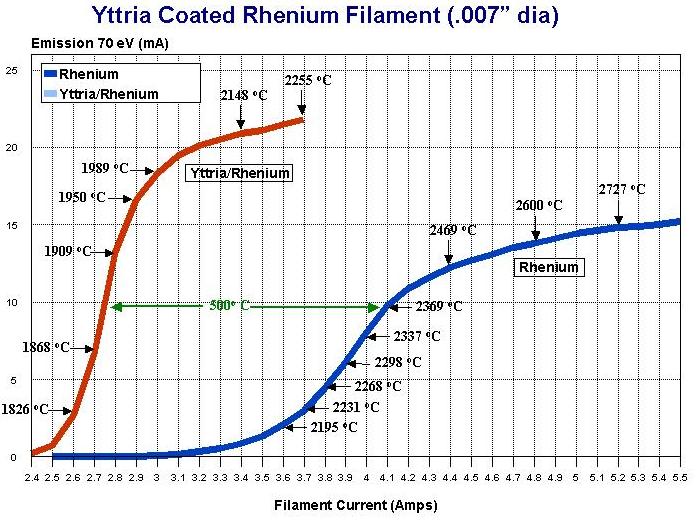
As shown in the chart (Figure 4), when the Rhenium filament is coated with Yttria it emits at a significantly lower filament current than the plain uncoated rhenium filament. The Yttria coated filament required about 70% of the current and power to obtain the same emission as the uncoated filament wire. Emission occurred at temperatures between 1850°C and 1950°C for the Yttria coated rhenium filament. The Yttria coated filament provides emission at about 500 lower in temperature than the uncoated filament to achieve the same emission current. This will result in good filament emission at a lower filament temperature and would be expected to produce longer filament life with the Yttria coated filaments.
Reproducibility of Yttria Coated Rhenium Filaments
A set of 9 rhenium (.0055" diameter) filaments were coated with Yttria to a thickness of 0.0007" to 0.0010" to determine the reproducibility of manufacturing these filaments. The results are shown in Figure 5. The filaments were very reproducible in the emission range of 0 to 10 milliamps of emission, but this variation was probably due to the variation in thickness of the Yttria coatings or variation in the distance between the filament and the collector since different mounting positions were used for each of the filaments in the testing station.
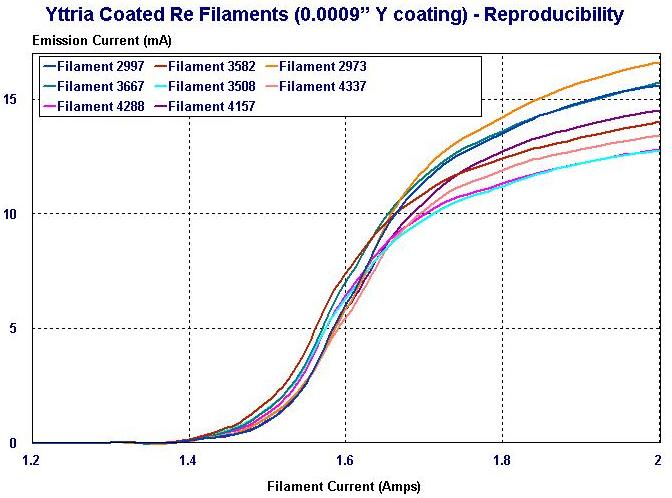
In general we have demonstrated that we can reproducibly produce filaments with our processes and that film thicknesses between 0.0005" and 0.0010" thick provide for optimum performance and uniform coatings of the filament surface.
Filament Testing on an Agilent MSD
The next study was done to compare the actual operation of the Yttria coated filaments in a mass spectrometer. Two filaments were installed in an Agilent 6890 MSD. The first filament (Filament #1) was a plain 0.0055" rhenium filament which is the standard filament normally used in the MSD. The second filament was the same style filament, 0.0055" rhenium, coated with Yttria to a thickness of 0.0005". The mass spectrometer was operated in the normal EI mode and was tuned with each filament using the standard Agilent ChemStation Autotune. In both cases the filament emission current was set to 34.96 in the ChemStation tune setup.
The standard uncoated rhenium filament (Filament #1) operated at a measured filament voltage of 2.059 Volts AC. The Yttria coated filament (Filament #2) operated at measured filament voltage of 1.455 volts, which is about 70% of the voltage requirements for the non Yttria coated filament. This data agrees with the previous study above in which filament current and power for the Yttria coated rhenium filament were reduced to 70% of that required for an uncoated filament. This reduction in filament voltage and conversely filament current results in lower filament temperature and it is expected that the filament life will be increased. However, actual lifetimes of Yttria coated filaments in a real world mass spectrometer requires additional testing. It has been reported that these filaments are subject to poisoning by inorganics such as Chlorine and Flourine. The Yttria coated filament has been used in our MSD for about 3 months now and is still working fine.
CONCLUSION
The above studies demonstrate the feasibility of using Yttria coated iridium and rhenium filaments in a mass spectrometer. Yttria is a good replacement for Thoria and eliminates the environmental problems associated with Thoria. Yttria coated filaments require less power than uncoated filaments and the filament operates at lower temperature to achieve the same emission as the uncoated filaments. Historically iridium has been used as a base metal for Thoria and Yttria coated filaments, however we have demonstrated that Rhenium is also a viable alternative to Iridium and may be superior. We have demonstated the SIS can reproducibly manufacture Yttria coated filaments to meet the end users requirements.
SIS Manufacture of Yttria Coated Filaments
SIS can now manufacture Yttria coated filaments. This can be done in a prototype and production environment. We can coat Iridium, Rhenium or Tungsten filaments with Yttria coating from 0.0025" to 0.0010" thickness. We can manufacture straight filament wires and ribbons as well as coil or pin shaped filaments. We also manufacture filament presses and custom design filament assemblies for our customers. We can work with you to develop and test filaments for your application and consult with you in your filament design. We have capabilities for small to large volume production quantities.